Sunday, February 5, 2012

Catching the Rooster

Our morning Spanish classes have the advantage of being in the patio of the house where we live.  There is shade, and it is usually delightfully cool there.  There is one disadvantage, however, of this spot.  There are 17 chickens and one rooster about 15 feet away from us.  On Friday the rooster suddenly started crowing in the middle of our class.  Our teacher, Rolando, raised his voice and attempted to continue. However, the rooster outdid him in both volume and persistence.  Finally Rolando couldn't take it any more.  "Let's grab the rooster!", he called as we all headed for the chicken coop.  Evidently if you separate the gallo from his gallinas he will stop his noise.  I entered the coop with Rolando, Señora Rita, our host mother, and one other PC trainee.  I soon had the rooster cornered.  He was trapped in the corner with a tree trunk on the third side.  All I had to do was grab him, but I had no clue as to how to do that.  I thought of grabbing the neck, but I didn't want to hurt him or get pecked on the hand.  He made a break for it and I let him go with a half-hearted attempt at a grab.  Austin, the other PC trainee, failed equally.  It was obvious that Rolando was going to have to do it.  I herded the rooster over to him and, sure enough, he grabbed it by the wing.  He handed it to Señora Rita, who flung it over the fence into a side pen and that was that - back to class!

Rolando gets the rooster as Austin looks on
Mama Rita takes care of "el gallo"

Saturday Night Fever!

What is there to do in a town of 2000 people on a Saturday night?  Evidently there is quite a lot, if last Saturday was anything to judge by.   Our first stop was the rodeo on the edge of town.  The event of the night was calf roping.  The object was just to get the noose tight around the neck of the calf - it wasn't necessary to tie it up.  The first three we saw missed completely, and we thought we were in for amateur hour.  Soon the best of the lineup came, and we saw people finish in three or four seconds. The top time was a stunning 1.97 seconds.


To accompany this was some typical Panamanian music.  These guys were right from the campo, and their music was lively.


We eventually tore ourselves away from the rodeo and headed for the center of town, where the athletic facility is an indoor soccer area with a cement floor and chain-link fence for walls.  That night it was taken over by a gigantic bingo game attended by most of the town.  One of the men in the town needed an operation, and didn't have the money.  Everyone pitched in and bought food and bingo cards to raise money.  They didn't announce how much they raised, but it was a significant amount.

Heather at the bingo table with Miranda, Nate and Austin

Heading back home, we found that next door four Peace Corps trainees with much more energy than we had were doing a P90X workout in the back yard.  No thanks!

One last activity that we didn't partake of was a huge birthday party about a block away.  They were blasting the music until 3 a.m., but no one called the authorities to complain. Needless to say we didn't sleep a whole lot that night.

Wednesday, February 1, 2012

Trainees First Day of Teaching English

All of the PC trainees had been having four hours of Spanish classes every day.  The top two levels, however, have now been reduced to two hours a day of classes.  During the other two hours they are teaching classes of English, for free, to people in the town.  Today was the first day of classes.  There were about 90 students divided into five groups by age, including a few adults.  There were many activities, and the students are eager to return again tomorrow.  There will be 9 days of two-hour classes, followed by a Saturday where English activities will take place all day with all 31 of the PC English teaching trainees taking part.

 
Heather and Jess teach the 10-11 year old children
Heather tosses the ball to a student in the "name game"
Heather and the class playing "Loose Caboose"

Tuesday, January 31, 2012

Site visits

For the past three nights we have been visiting different PC volunteers in their sites.  The object of this is to get a better view of what it is like to be a PC volunteer.  Steve went to a mountain town of 220 people in the province of Coclé.  The only access was a mile and a half walk via a muddy path which is in the process of being made into a paved road.  The countryside was stunningly beautiful, as you can see below. If you hike a couple of hours up into the mountains you can see the Pacific Ocean.  There is also a point along the continental divide where you can see both oceans, but it is hard to get to.

Jake, the PC volunteer on the site, has been very active.  His projects include making clay or brick ovens which are very fuel-efficient, solar panels to bring electricity to the outskirts of the village (the center has electricity), reforestation, and growing sustainable crops.  Jake has done a fantastic job of integrating into the community.  The kids in the village all love him.  It's like watching the Pied Piper when he goes past their houses.

The people in the village were wonderfully friendly and open.  I had a great time swimming  and playing tag in the river with Jake and the village kids.  On my last day there his host mother made "arroz con pollo", the national dish, which was absolutely delicious.  It's not just chicken and rice - there are lots of tasty herbs, veggies and seasonings.

You can see the continental divide in the distance
 One of the projects a few years ago was to raise pet iguanas because they are getting scarce.  Many families still have iguana cages today.  Years ago people ate iguanas but there are too few now.  I was told that "they taste like chicken".

Pet Iguanas
Young ones are green!


The village had the most amazing community farm in the school grounds.  There are 38 houses in the village, 31 of which have kids in the local K-6 school.  They have turned the school grounds into an organic farm which feeds the kids lunch every day.  The mothers take turns cooking, and the fathers tend the crops and guard the chickens, which need to be watched 24/7.  They eat the eggs throughout the school year, and eat the chickens on the last day of school.  They grow just about every crop that there is around here, including pineapples, rice, papaya, bananas, herbs, peppers, beans, plus the usual root vegetables. They also have worm beds to provide organic fertilizer.  When the huge mango tree is ripe, there are literallly hundreds of mangoes to feast on.

Santos, president of the parents association, and Jake on the school grounds
 Jake's house is of dried mud construction, as are most houses there.  It dries very hard and strong.  He prefers not to have electricity even though there is electricity in the house next door.

Jake's house

Heather visited an English teaching volunteer, Kali, in the province of Veraguas near the city of Santiago.  Veraguas gets its name from the fact that it is the only province in Panama which touches both the Atlantic and Pacific Oceans.  Kali showed her around her village of 3500 inhabitants. On their walk around the village she was introduced to a variety of community members.  She was able to see the local school.  It was set back on a side street away from the main road. They spent a lot of time sharing teaching ideas.  They visited a rural farm where  they visited Kali's favorite family and spent some time in the city of Santiago where the Normal School is located.  This is the institution which trains teachers. She also had a chance to swim at a hotel pool!  On Sunday the village had a festival which provided an opportunity to see traditional dance performed by local children.


A walk in the countryside

Traditional dress for folk dance

This boy reminded me of a Diego Rivera portrait

Thursday, January 26, 2012

El Rio

We have been pretty busy these past few days, with classes 8 hours a day.  Today we had an "self-directed" day, where we planned and carried out our own activities.  Fortunately this left time for a trip to "El Rio", a popular swimming hole near the town where the environmental trainees are staying.  I had fun jumping off the tree into the river.  It was a great way to cool off and enjoy the afternoon.

Wednesday, January 25, 2012

Gardening Day

On Saturday we had a change of pace from our classes and training sessions.  All of the environment group worked in the field.  We were at our normal meeting place, the farm where we have our classes.  The owner, Arnulfo, has been very kind to us to let us use his "rancho", an area covered with a thatched roof, for our classroom.  He gives us food and drink for our break each day.  Sometimes he gives us coffee that he has raised and harvested on his land, or fresh oranges or papaya from his trees.  On Saturday he led us around the farm, which is almost four acres, showing us the great variety of useful things growing there.  He has oranges, bananas, plantains, breadfruit, guava, coffee, cacao, yucca, grapefruit, limes, pepper, teak trees, plus several things we don't hear of in the US, like limon mandarin, which looks like a lime on the outside but is like a mandarin orange on the inside.  There are several others for which I couldn't find English translations: guanavana, chayote, noni, guava, marañon, yampi, otoe, and ñame. The fenceposts which border his property are all alive, made of the "balo" tree.  Each fencepost is kept trimmed so that it doesn't take up too much space, and the leaves are very useful because they are able to fix nitrogen from the atmosphere.  We created three piles of compost with different recipes, we prepared and planted a few rows of beans, peppers, squash and watermelon, and then we worked on a "magic circle", which consists of a pit of decaying organic matter surrounded by various plants of different height.  


We had a lot of fun swinging machetes as we had to chop up a few old banana trees to provide material for the pit.  It turns out banana trees have a honeycomb structure in the trunk and are mostly air and water with little substance to them.  They are actually very easy to hack up with a machete.

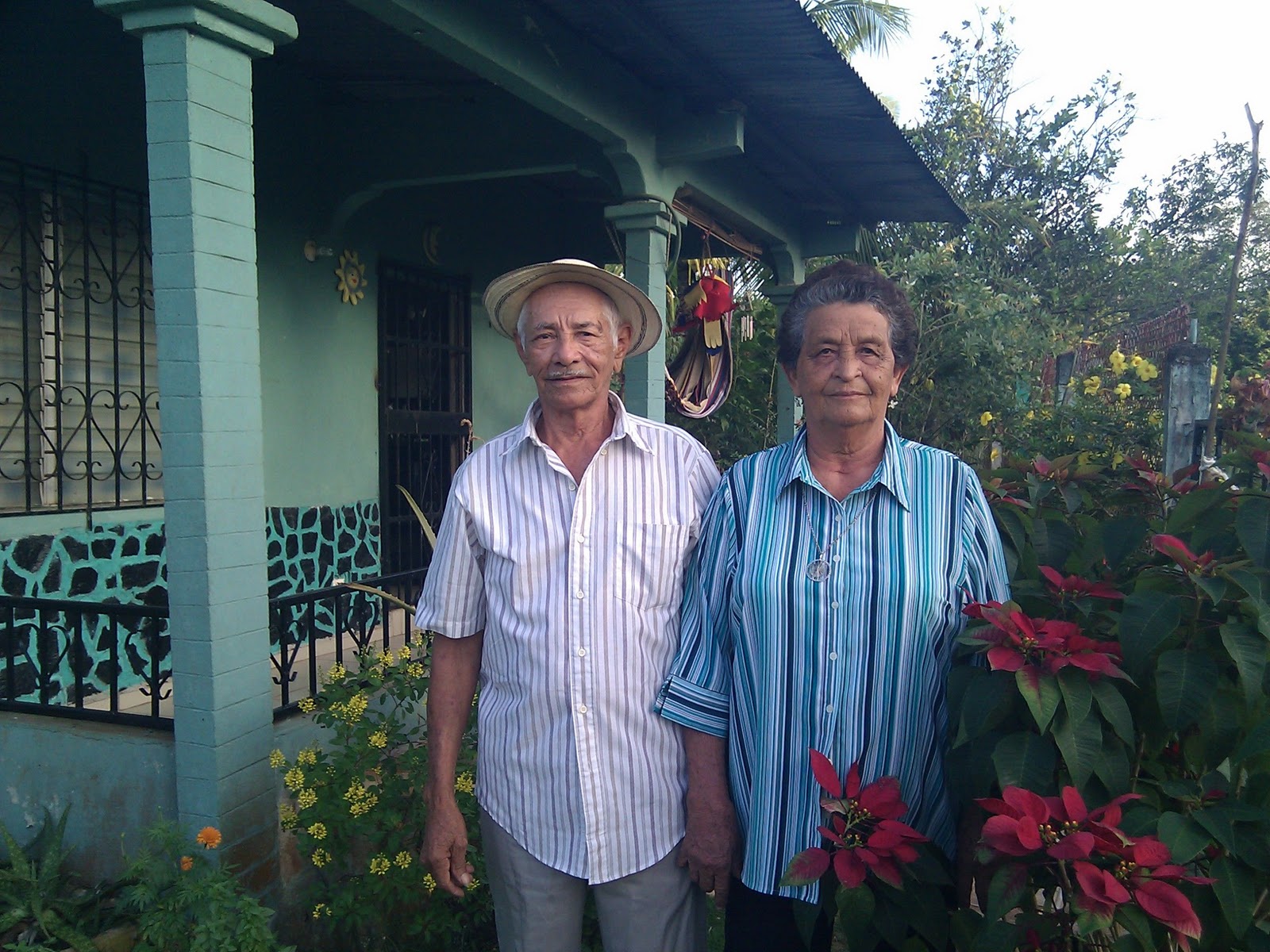
Here is an updated picture of our host family in front of the house.  Note the poinsettia bush!


Friday, January 20, 2012

With Our Host Family

On Sunday we finished our training at the Peace Corps office in Ciudad del Saber near Panama City and moved in with our host family in a town of around 2000 people about an hour west of there.  The English teaching trainees are in one town, and the environmental people are in another a few miles away.  Heather and I live with the English group.

Our host parents are Rita and Rogelio.  They have three daughters who live in the town, ten grandchildren, and a lot of great-grandchildren.  We met most of their family on the first day as they stopped by the house to meet us and introduce Peace Corps trainees who were staying with them.  Everyone we have met here has been very friendly.  Complete strangers will smile and greet us in the street of our town.
Rogelio and Rita
Here is their house.  They have a covered patio in the back, where we spend most of our time.  They have a rooster, seventeen chickens, two ducks and a parrot who doesn't fly or talk.  We learned early on that theirs is not the only rooster in town.  The roosters crow periodically all night, but they really crow in earnest from about 4:30 am.  We have earplugs, which help to reduce but not eliminate the noise.


We have a very nice room, and the house has a flush toilet and indoor shower.  Sometimes the water is diverted to another part of town and we take bucket showers and use an outhouse, but most of the time there is water.

The weather here has been great.  We were prepared for hot humid weather with lots of mosquitoes, but we are in the dry season and the humidity is typically around 60% or so.  The mornings and evenings are cool and pleasant in the 70's.  Even though it gets up to 90 in the middle of the day, there is usually a breeze.  We have been warned that this is the best weather of the year.  In late April the wet season will start and the humidity and bug level will increase.

Our schedule is very full.  We have Spanish class from 8am to noon from Monday to Thursday, with technical classes from 1 to 5 pm. We are lucky to have the Spanish class at the house where we live, on the nice breezy patio.  Since we are in the top level class, we only have to have two hours a day starting next week.  


Our patio/classroom/dining area

The food has been very tasty so far, and several of our group's Spanish teachers often meet at our house to have Señora Rita's midday meal with us.  We have been getting lots of practice with our Spanish!

A typical lunch or dinner might be a big plate of rice, with a piece of chicken, fish or beef and a bowl of lentil soup or broth with potato or yucca, always with some interesting flavoring.  Even though a lot of fruit is produced in Panama, most families don't eat fruit very often.  The stores in our town don't even sell pineapples, even though they are in season and plentiful in the nearby city.

 On Fridays we go to the Peace Corps office in Panama City for training sessions.   Saturday Steve will be working in a farm and Heather will be doing an English workshop.  On Sunday we have to take public transport to Panama City for a scavenger hunt and some free time in the city.

We are still having a great time and enjoying the company of our fellow trainees!

Saturday, January 14, 2012

Site Visit

Today all of the environmental volunteers visited a Peace Corps worker at her site.  It was an hour or so north of Panama City, on the Chagres River, which is the largest river in Panama, and flows into the Panama Canal.  It is the only river in the world which flows into both the Atlantic and Pacific.  We visited  an indigenous site, inhabited by the Envera tribe.  We had to cross the river in a dugout canoe to get to the village.  It was a big canoe, holding up to 15 people.  It was made from one huge log, hollowed out by two people, taking two to three months to complete.  They last a long time.  This one was 19 years old.  It leaked a bit of water, but not much.


We all really enjoyed the visit.  We saw the projects the PC volunteer had created, which included homemade clay ovens, and a solar panel to give electricity to the school.  The village has no electricity, and has running water most of the year.  By the end of the dry season, the water level is very low because it all is used by boats going through the locks of the canal.  Each time a boat goes through it releases a great deal of water into the ocean.  During this period they need to use water from the river.

 We also visited her house, which was very nice inside.

While it is unlikely that Heather and I will be in a village like this, it was very interesting to see what a PC volunteer does in an indigenous village.