Friday, August 30, 2013

Scariest Snake Story Ever!

Earlier this month we went for a walk to the neighboring town of El Toro, where some of our students live.  We stopped by the house of two sisters in eighth grade, where we met their family.  There are nine siblings in the family - an older brother and eight younger sisters!  The sisters were quite shy, hanging back in the doorway while we sat on the front porch and conversed with the brother and father.  The father told us an amazing story about his encounter with an "equis" (X) snake, also known as the fer-de-lance.  The snakes have an "X" pattern on their back, hence the name.  These snakes are one of the most poisonous there are.  If you don't get the proper serum within a few hours, it can be fatal.

Plinio, the father, told us that he was up in the hills one day about three years ago, clearing underbrush with a machete.  As he was chopping away, he accidentally chopped a five-foot "equis" in half.  This was enough to make the snake furious, but not enough to kill him right away.  With his remaining strength, the snake twisted around and bit Plinio on the foot.  The teeth went right through his shoe.  The teeth were so sharp that Plinio said he hardly felt a thing.  The snake, sensing its imminent death, unloaded all of its venom at once.  Usually a snake will keep some in reserve in case it needs to attack again, but not this time.  In less than a minute, an intense pain rushed through Plinio's whole body, and he fell to the ground.  There was only one other person with him, and they knew that they had to get him to a doctor soon.  Plinio managed to hobble home with the help of his friend, and soon he was in the ambulance headed down the mountain.  His lower body began to swell up, all the way from his foot to his abdomen.  They arrived at Las Minas, the nearest town, only to find out that the health center was out of the serum he needed.  They sped off to the next town, Ocú, where there was a hospital.  They were out, too.  Time was running out as they headed to a third town with the same result.  Finally they arrived at the provincial capital Chitré, where the main hospital had the serum.  It was 11pm by that time, nine hours after he had been bitten.  By that time he was unconscious, and his lower body was swollen to twice its normal size.

 Plinio must be a pretty tough guy, because they say that if you don't get the serum within six or seven hours, you are in serious trouble.  It took several months, but Plinio made a complete recovery.  He said that for a very long time he couldn't straighten out his leg, but eventually he was back to normal.   The most amazing thing, though, was that after telling us this whole story, Plinio added that that was the third time he had been bitten by an equis!  We didn't dare ask for the story of the other incidents, if only to spare his family from having to hear Plinio retell things yet again.  We got the feeling that they had heard him tell his snake stories quite often over the past few years.

Plinio left us with a final word of advice:  "If you´re going to kill an equis with a machete, make sure you chop it right behind the head so he can´t go after you with half his body."  I doubt that we will forget that!

On a happier note, the neighborhood kids have been coming around to our house a lot.  They play lots of games on our front porch.  We were lucky to receive several card games from a former Peace Corps volunteer during the celebration in June of the 50th anniversary of the Peace Corps.  There are many of the standard games, like Uno, Old Maid, and Crazy Eights, which they like a lot.  We have also taught them The Great Dalmuti.  Their favorite, though, is a memory game with 50 cards, each card having a beautiful drawing of a rain forest animal, like a macaw, an anteater, or a quetzal.  These are all animals that they know of here in Panama, and the game is much more interesting than using a normal deck of playing cards.


The rain forest animal cards
Playing the game

They also love to imitate what they see on TV.  Here you see two girls giving their version of "Dancing with the Stars"  It is hilarious to watch them.

Yeimys (grade 5) spins with Alexandra (K) during their performance


As much as the kids like card games and dancing, a new activity, best described as "porch sliding rope swinging mania", has taken over.  The kids now want to do nothing else when they come over.  We have two hammocks on the front porch, but when it rains we take them in, leaving the ropes hanging.  The kids discovered that the ropes and a wet porch are the perfect combination for some sliding fun.  We added wooden handles for a better grip.  These young kids can get quite acrobatic!


Click here to see these kids in action.  We especially like the sliding dismount!  Steve resisted, but eventually joined in.  See him here.

The outside of our house has become quite the spider colony.  We have over a dozen of these big spiders, called Golden Orb Weavers after their yellow webs. They look scary, but they don't bother us.  They certainly help keep down the insect population.  Whenever Heather catches a fly, she feeds it to the spider living outside the bathroom window.  We don't need a screen with this web outside the window.

Mother and daughter keep the flies out

A few years ago, Peace Corps volunteers developed a program for teenagers to help them to set goals for the future and make plans to achieve those goals.  Much of this involves encouraging them to continue with their education and to put off having kids until they are older.  Teenage pregnancy is quite prevalent here, especially in rural areas. We teach them how to avoid STI's and unwanted pregnancy.  We and our fellow Peace Corps friends have given these one-day workshops to the eighth and ninth graders here in Chepo.  We plan to do the seventh graders in October.

Nico and Steve explain how not to use a condom


Students act out the immune system under attack by HIV

Steve is on the board of the Gender and Development (GAD) committee, which is in charge of developing materials for the talks described above.  There are also workshops for adults on various health issues.  Recently the board met for a weekend retreat in the tourist town of Santa Fe, in the province of Veraguas, where they revised the materials for the various workshops and planned youth camps for "summer" vacation in January.


Chepo is in the forest preserve of El Montuoso and so is host to lots of government agencies who come to do environmental projects.  This past Wednesday one agency came with 500 seedlings of various types.  Students, teachers, and manual workers at the school pitched in to plant them all in one morning.  Even our two local policemen took part.


It is corn season now in Chepo.  A very popular thing to do with "new" (soft) corn, is to make bollos.  Each corn cob is scraped clean, and the corn is ground up.  The resulting dough is mixed with butter and wrapped in corn husks so that it is the same shape as a corn cob.  It is then boiled and eaten.  Sometimes it tastes really good, and sometimes not so good, depending on who makes it.

Two generations of bollo makers

That's it for now!

Steve and Heather

Monday, July 29, 2013

Surf's Up!

 This past weekend we decided to head for the beach for a little relaxation.  We went to visit our fellow Peace Corps volunteer Sally in her town near Cambutal Beach on the south coast of our peninsula.  Neither our town nor hers is near a major road, so we had to take five different trucks and buses (and six hours!) to get there.  Friday night we stayed at a lovely hostel with a view of the beach.

The view from the hostel

A nice place to relax!

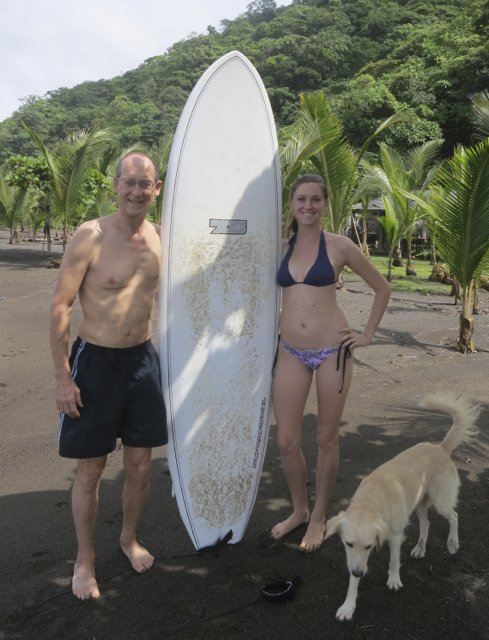
Saturday morning we woke up to steady rain.  After all, it is the rainy season here from May until December.  Fortunately the rain stopped after breakfast and by mid-morning the beach was sunny. Sally and Steve borrowed a beginner surfboard, and Heather went along to document the event.  Steve had not been surfing since the early days of the Southbank School in London, during their outdoor education weeks.  That was 30 years ago!  His goal was just to stand up on the board.  He was happy that he was able to get a few rides and stand up three or four times for a few seconds!

Steve and Sally get ready to surf!


While we were there, three men showed up and set up their motorized parachutes with a big fan located behind the operator.  The gasoline motors were pretty loud, but it looked like fun.  We probably won't try it though, as trees and power lines could be a problem if the wind picks up!

Getting ready to launch

These three disappeared into the morning sky

There were some nice little cabañas on the shore.  Maybe on a future visit we will try them.


After the surfing, we headed to Sally's town a short distance inland.  She introduced us to the families in her town and took us on a tour.

It's never too early to start to ride!
This iguana project is supposed to take some pressure off the endangered iguanas in the wild.  The owners will either eat or sell them.


 The big event of the year in her town was the baile (dance) on Saturday night.  Sally was not able to attend last year due to a Peace Corps training event, so she really wanted to see this one.  The baile started early with a cantadera, which is part singing contest, part poetry slam.  Two men start out, each singing a décima, which is a ten-line song with eight syllables per line and a certain rhyming scheme which has to be followed.  One singer starts out with a décima with a particular theme, usually something simple like the characteristics of men, women, or love.  The other singer has to decide if he agrees with the first person or not, usually not.  He offers a décima of his own.  They alternate for several times, each one trying to outdo the other.  One will make some arguing points, and the other will rebut and offer opposing points.  After the first couple of rounds, they have to make up their décimas on the spot, which to us seems like a very difficult thing to do.  These guys, however, have lots of experience and make it look easy.  All this goes on for a few hours before the dancing begins.


The man in the dark blue is thinking up his next décima while the other man sings.

You may have noticed the bottles on the table in the last picture.  There was a lot of drinking going on, which is normal for a baile.  Beers were 75 cents each (three times the store price), which made them accessible to all.  The real bargain, though was the seco, a kind of rum made from sugar cane.  A liter of seco only costs a few dollars.  Usually it is mixed with ice and a soft drink, but we saw a lot of people drinking straight from the bottle.

There are lots of seco bottles around
We were happy that we were able to drink a beer or two in public without a problem. In Chepo, it is illegal to buy liquor anywhere, so we don't drink in our town.  At the baile, however, the townspeople expected us to drink.

Around 11 pm they cleared away the tables in the center of the area and people started dancing to Panamanian tipico music, which was quite lively.  The main instrument in the band was the accordion, which was accompanied by a bass guitar and three drummers.  They alternated between a male and female singer, and both were quite good.  In order to dance, men each had to pay $5.00.  (We thought this price was a little steep - after all, $5.00 is almost seven beers!),  A bright green paper was stapled to each man's collar after paying.  The price was really $5.00 per couple, as the women weren't charged anything.  The dancing was very popular, with the dance floor filled to capacity for each dance with couples of all ages.  We left around midnight, but the band kept going until around 3:30.

On Sunday morning, we left early so that we could be home in time to watch the US-Panama soccer final of the Gold Cup (Central and North America).  We went over to our neighbors' house with two flags (one of each country) to see the game.  At half time we made popcorn for everyone, and they made us a delicious dessert from local fruits.  We felt badly for our hosts when the US scored the goal and went ahead.  They took it pretty well.  "Someone had to win," said one of them.

In mid-July the University of Panama celebrated 75 years of their English program with a week-long congress at the Panama City campus. Heather and a few other Peace Corps Volunteers in the Teaching English program made presentations at the congress.  Steve tagged along and we spent three nights in the city. We met up with lots of Peace Corps friends who were in the city for various reasons. On Saturday night we had tickets to see Elton John and Tim Rice's Aida, the musical.  We  were so excited to finally see the inside of the National Theatre where it was held, and the production of Aida was first class.  

The National Theater of Panama

We found out last month that the Peace Corps will be coming to Chepo for in-service training  for six nights in September.  The most recent group of environmental volunteers (24 in total), arrived in Panama in February.  They have been in their communities for a few months now, so they have had time to decide which projects will be best for their sites.  They will be training here in making stoves, reforestation, gardening, and other topics.  Steve has a lot of organizing to do in the meantime, as host families have to be found for everyone, and lunches and training activities arranged.  We are honored that they chose our town for this important event.  Now we just have to make sure it all happens smoothly!

Well, that's it for now.  
Steve and Heather


Saturday, July 6, 2013

Peace Corps 50th Reunion

 This past weekend was a special one.  The Peace Corps is celebrating its 50th reunion this year, and each country has a celebration sometime during the year.  This week it was Panama's turn.  Past (Returned) Peace Corps volunteers (in PC lingo - RPCV's) came from all over for various activities in Panama City.  On the weekend they dispersed to the various provinces where they had served. Many of them were here in Panama during the 60's, and hadn't been back to their communities in over 40 years.  They were a fun-loving group, and we had a good time with them at lunch, and then later at a local restaurant for happy hour.

Old timers and current volunteers

One woman brought lots of pictures of her stay in the neighboring province of Los Santos.  It was fascinating to look at pictures from the late 60's and to see how much has changed in Panama and how much still remains the same.  Here are a few:

This woman knows how to carry a heavy load!

This iguana is headed for the dinner table! 

In those days, making houses from mud was a common practice.  They got huge groups of people together to put up the wooden frame, mix the mud, and put it up on the wall.

First, they erected the frame of the house

Then it was time to mix the mud and straw for the bricks

Finally the mud goes up on the house walls.

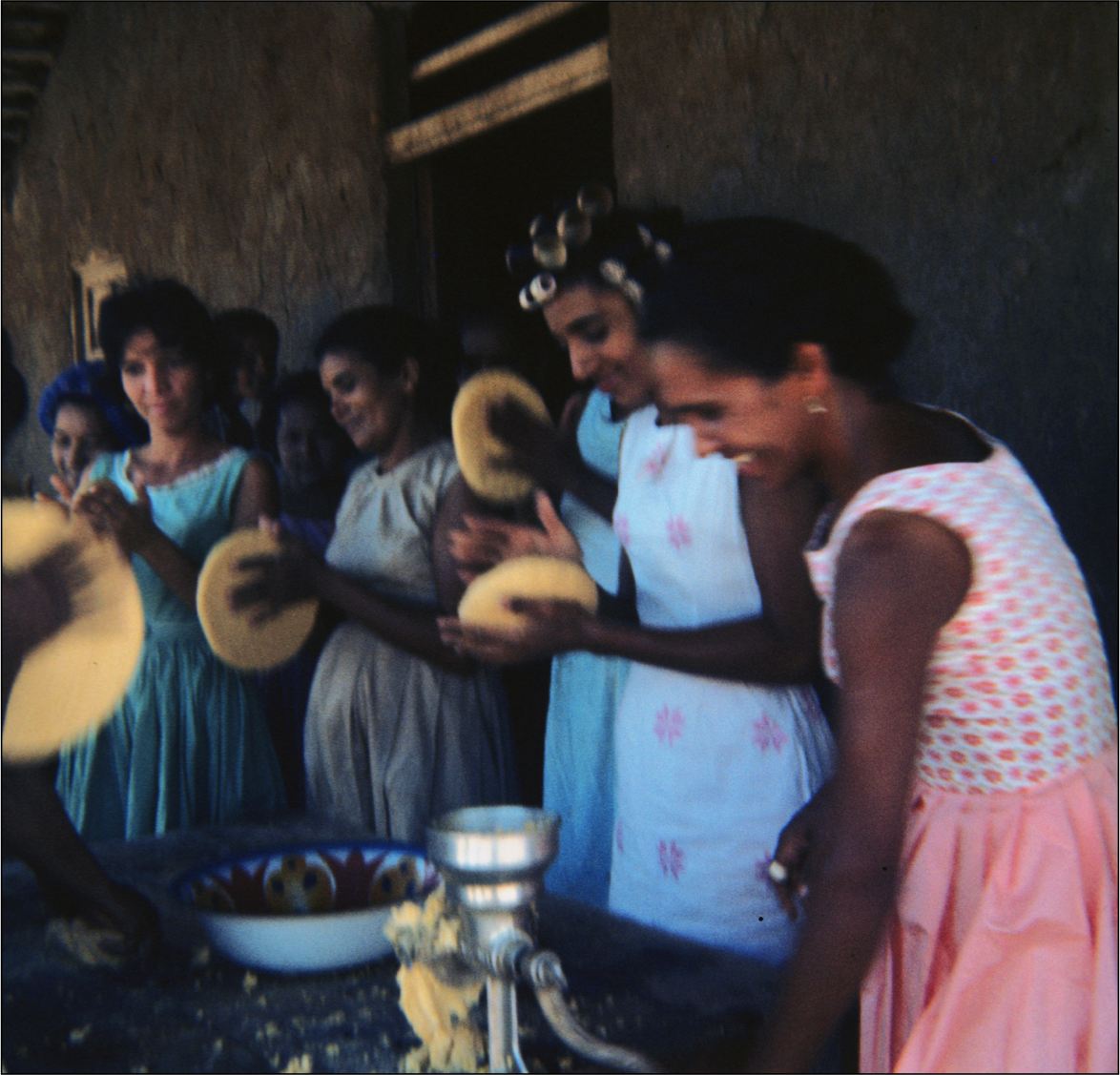
All those men need to eat a lot of tortillas!

Tortillas on the fire

Nowadays in Chepo, almost all of the construction is with cement blocks (cinderblocks).  To save money, they mix their own cement and form the blocks in a mold here in Chepo.  Some houses are made of wood, and a few mud houses still survive here.  Our neighbor just added on a room to his house, and did so using the same technique illustrated above.  Since it was just a couple of walls, he only needed a few people to help.  Unfortunately we weren't  there to witness the construction, but here is a shot of the finished product.


Also, in Chepo now they don't get together in huge groups to make houses or to help harvest crops like they did in the past.  It's harder to get people to work together towards a common goal.  People are busy with their own affairs.

We had some time to talk to the RPCV's about their experiences both here in Panama and afterwards in the US.  The Peace Corps back then was a lot more loosely organized.  They would often send someone to a town and tell them to do what they thought the town needed.  Sometimes it took quite a while to find someone to work with in the town and to decide on a project that was needed by the community and was within the skill set of the volunteer.  These days the Peace Corps researches each town throughly before they send in a new volunteer.  People in the town need to affirm ahead of time that they want to work with the volunteer on certain projects.

It was interesting to hear the RPCV's talk about their re-entry into the US.  Sometimes it was a bit of a culture shock to go back home.  They had lots of things they wanted to share with people back home, but often people back home didn't want to hear very much about it because it was so far out of their realm of experience.  They asked a few basic questions and then changed the subject.  Several people said that they had changed a lot in the Peace Corps, but that people back home expected them to be the same.  I think this is one reason why most areas in the US have active RPCV organizations.  People who have done Peace Corps like sharing their experiences with each other, and these organizations often promote programs in developing countries, so that their members can continue helping others after coming home.

We are hoping that those of you reading our blog will know enough about what goes on here to have to have some good conversations with us on our return!  We can't believe that we have only 8 months to go.  The time has really flown by.

Will we come back to visit Panama after we leave?  We definitely plan to come back, though I don't think we will wait 40 years to do so!  Since we will be retired, we plan on coming back every few years to see how our friends in the town are doing.

A few days ago, we were in our house and heard a pig squealing and dogs barking.  A pig had fallen off a truck right in front of our house.  Its front legs were tied together so that it couldn't walk.    Our neighbor Andrés grabbed the pig by an ear and the tail and slid it into a mud puddle.  Heather doused the pig with a bucket of water, as it was a hot day.  We untied the front legs, and tied a rope onto the back legs so that Andrés could walk the pig home to his house. It turns out that the best way to walk a pig is with a rope on its hind legs, as you can see in the photo below.


A few days later a boy from a neighboring town came looking for his pig, and he gave Andrés $6 for taking care of the pig.

That's it for this week!


Steve and Heather

Monday, June 24, 2013

40th Anniversary Week

This past week was a special one.  Our middle school celebrated its 40th anniversary.  When the school was founded in 1973, the area was very sparsely populated.  President Omar Torrijos was in power, and he built many schools throughout rural areas.  There were only 40 students in grades 7 to 9.  Now we have 170. 

The first event of the week was the torchlight parade through the town on Monday evening.  Students from grades 1 to 9 paraded along the highway which runs through the town, each with their torch containing a burning bottle of kerosene.  It still amazes us that no one gets hurt in these events.  We certainly would hesitate to have our first grade son or daughter carrying one of those torches!


Middle schoolers with their torches

Primary school students

These girls got to carry the banner


On Tuesday a queen was chosen from 11 candidates who ranged from kindergarten to ninth grade.  The day started with a pickup truck parade through the town.  Each girl had her own color, and decorated her truck to match.


The girls then changed out of their jeans and into dresses for the final event.  There were three first graders and one kindergartener among the group.  As you can see from this photo, they don't seem overjoyed about dressing up and putting on lots of makeup.  The families of the girls had a lot more fun preparing for the contest than the girls themselves.


These girls are actually a lot happier climbing trees and playing in the mud.  Here are a few pictures to illustrate our point:


Yaritzel in her dress


Yaritzel climbing a tree

Diana and her escort, Kendedy

Diana and her brother making bricks

Alexandra

Alexandra and her sister climbing rocks

Yohannys
Yohannys on a vine


The candidates were presented one by one and danced their way to the stage, accompanied by their escorts.  Flags were waved and candy tossed to the spectators.


 The winner was chosen by drawing paper flowers out of a pot.  One flower contained the winning slip of paper.  


The candidates eagerly open their flowers to find out who won. The reigning queen watches from the far right.

Here is the newly crowned queen and her escort.  


As luck would have it, a thunderstorm struck just as the queen was being crowned.  This picture shows the torrents of water coming off the roof.  The wind started blowing very hard, and water started coming into the area, as there are no walls on the cancha where the contest took place.


Eventually the storm stopped, and everyone was able to leave.  Fortunately the area was quite big and most of the people could fit on the dry half.

Thursday of last week was the day of the Montuoso Forest Preserve.  Groups of dancers and musicians came from all over the province to perform at our school. The school put up a hut to illustrate the handicrafts of the area.


Serafina put on her pollera, the dress worn to folkloric events.


This group came from the regional capital, Chitre.


These two boys wore the traditional masks of the area as they performed their dance.  


That's it for this week!  Next week should be a lot less eventful, but you never know!

Steve and Heather