Monday, February 25, 2013

Waterfall


A couple of weeks ago we went back to one of our favorite spots, the El Salto waterfall.  We had been twice in December, and it was interesting to see how much the water level had fallen since then.  The wet season ends in late December, and we have virtually no rain from January through March.


Of course we love to swim in this pool.  The water is very clear and cold.  It's too bad we have to walk an hour and a half to get here.  Sometimes we get a ride back for part of the way.  


On the way home from the waterfall, we saw this cow with a twisted horn and thought it was worth a picture.  Note that she is wearing a stick on her neck to keep her from going through fences.


Quinciñera

We were invited to a small town near here for a 15th birthday party for a girl who goes to school in Chepo.  It was a big event with lots of people attending.  One of the customs is for the father to put a ring on his daughter.


Because this is an Evangelical community, there was no dancing, and no alcohol.  There was a speech from our host father Aristides, who is also an Evangelical pastor.  

Afterwards there was lots of food for everyone (over 100 people).  Here are the pots of arroz con puerco,  (rice with pork).


Los Ceibos Again

We decided that we would make mud brick stoves for two of the families in the community of Los Ceibos.  This was our third visit.  We descended 1000 ft on the dirt path to the tiny hamlet.  There are only six houses there, only three of which have families in them now.  We really like the people who live there, so we didn't mind making the trip.   

Heather helped make bricks this time.


These kids were a little reluctant to get involved, but they did help make several of the bricks.


Here is the family with the finished product.  We will go back to the village on Sunday to help them assemble the stoves.


It wasn't all work on our trip.  We also took a trip to the swimming hole.  They let Heather ride the horse down the hill.


The kids love posing for pictures.  Here they are with their horse.


Visiting Amy

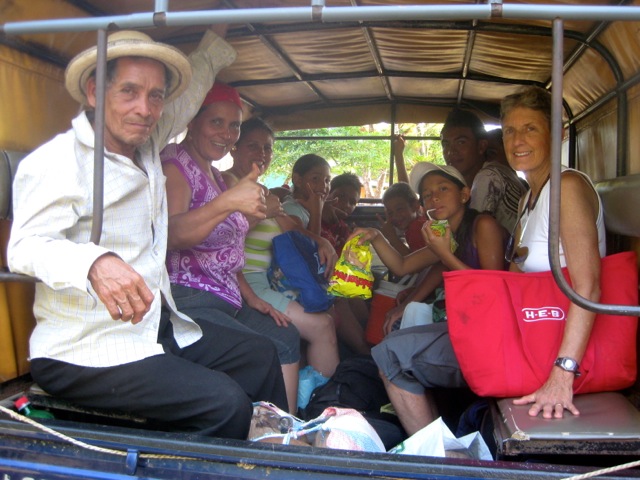
This past week we decided to visit a fellow Peace Corps volunteer in her town which is a half hour ride in a pickup truck transport from Chepo.  She has a delightful wooden house with a thatched roof.  She doesn't have electricity, though.


She took us for a walk through her town.  Along the way we spotted these two pigs sleeping by the side of the road.


The next day ANAM, the Panamanian environmental agency, came to Amy's school.  They gave a talk on how to make soap from old cooking oil.  Later, they handed out bags of gifts to all of the younger kids.  Each bag contained school supplies, including a backpack, and a uniform.  Each bag was donated by a different person, whose name was on the bag.  Last year the government provided new backpacks with school supplies to each student from grades 1 to 9.  This year they are not doing this, so private donors had to be found to fill the gap for some of the poorest communities.


Back to school!

School starts for all Panamanians in grades K-12 on February 25th.  The students have been on summer vacation since mid-December.  We visited the Chepo school last week, expecting to see preparations underway.  The boy's dorm looked much as it did on the first week of summer vacation.  We're glad we don't have to sleep on those mattresses!


We recently went to Panama City for Peace Corps meetings and took some time to visit an aquarium there run by the Smithsonian Institute.   They had one set of tanks for Caribbean fish and another for Pacific fish.  The Caribbean is warmer, clearer and more salty, so the most colorful life is found there.


Making more bricks

Steve continues to help the townspeople of Chepo to make mud brick stoves.  The latest count is 21 sets of bricks made, and 11 working stoves so far.  He is lucky to have a group of kids who love to help him.  They travel around the town helping him with his work.  


Mixing the mud for the bricks

They love getting their feet dirty!
Itzel helps Damiana with her stove


That's it for this week.  School starts today!

Saturday, February 9, 2013

Cane Syrup


This past week we went to see one of our neighbors operate his trapiche, a machine for getting the juice out of sugar cane.  This horse-drawn device squeezes the sugar cane between two rollers just like the old washing machines used to do.  It's a lot of work both for the horse and the man feeding the sugar cane into the rollers.  Kino usually works for four or five hours straight to process the sugar cane.

Kino feeds the sugar cane into the rollers as his grandson Kevin looks on.


Each stalk of sugar cane goes through the rollers three times.  The third time Kino twists three stalks together to get the last bit of liquid out.

Here you can see the whole setup.  Kino's granddaughter Macurys rides the horse around in a circle for hours, switching off with Kevin, who assists his grandfather by handing the stalks back to him for another trip through the rollers.  You can see the cane juice flowing out and into the bucket.


Macurys rides the horse.  You can see the pile of old sugar cane stalks behind her.


The cane juice is boiled for a while in the big drum, and then transferred to the smaller pot to be boiled down into cane syrup.  The finished product looks like maple syrup and sells for $1.25 a liter.


Swimming Lessons

We go to the swimming hole about three times a week.  Heather often reads books to children in the center of town in the morning, followed by a trip to the river.  It's a great incentive for the kids to come to her class.  The younger kids in the group take advantage of Heather's prowess as a swimming instructor.  Many have made significant progress this summer.  We all have to take breaks to warm up, as the water is quite chilly. 

Yarisel swims to Heather while Alex waits his turn.


We end this week's blog with a picture of our neighbors Mayka, age 6, and Meicol, age 10.  They were sent by their parents on an errand to deliver two sacks of rice to the piladora, where the outer coating is ground off to leave white rice.  Fortunately the horse is pretty docile!


That's it for this week!

Steve and Heather

Monday, January 28, 2013

Making more bricks

The dry season is the best time to make mud bricks for stoves, and it only lasts three months. There is a lot to do in a short time, and Steve has been busy.  On Wednesday he helped assemble stoves for three families who had made bricks earlier, and on Friday he helped make five more sets of bricks for more stoves.  Fortunately he doesn't have to do all of the work.  The idea is to train each family how to do it and have them do as much of the process as possible.  

Kevin, age 10, and his cousin Mayka, age 6, were some of Steve's best helpers.  Kevin made two complete sets of bricks for his grandparents and his uncle.  Mayka was a great assistant.  

Kevin and Mayka help stomp in the mud

They teamed up to make the bricks

Here Isidro shows the two sets of bricks that he made.  He is a really strong guy and the work went very quickly.


Los Ceibos again

On Tuesday we made another visit to the village of Los Ceibos.  We had visited last July, and the invitation to return was open.  Since school is on vacation, it seemed like a good time to make the trip.  Los Ceibos is a tiny village, consisting of only six houses - one extended family.  It is not often visited by outsiders because the only way to get there is by going to Chepo first and then descending over 1000 feet.  There are several steep descents, most notably el picacho.  It is very steep and full of loose dirt and gravel.  The footing is treacherous for us but the kids go down it like mountain goats, wearing nothing more than sandals.

Heather and Any on El Picacho

Los Ceibos is not on the road to anywhere.  The reason we went is because seven students from the Chepo school live there, and we wanted to see their community.  We later found out that no Peace Corps members have ever visited the village.  In fact, we also discovered that we may be the only gringos to have ever made the trip, so we got a warm welcome from the villagers.

When we got to the first house, they invited us to sit on their porch and served us a huge lunch.  We met several of the family members.  There are ten children in the family, the youngest of which are going into sixth, eighth and ninth grade.  The others all have continued their education outside Chepo and most have a university degree.  They work in cities and come back to visit from time to time.  

We were very impressed that the income from a small family farm would allow them to educate so many of their children to that level.  The family home was modest, made partly of wood walls and partly of mud walls, with a dirt floor and a roof of thatch and corrugated steel.  There is a great deal of assistance from the Panamanian government for families wanting to educate their children.  

Unfortunately the second house in the village was the one where we were also expected for lunch. Any, a recently graduated ninth grader, had killed a chicken and prepared a delicious soup for us.  We resolved that issue by going to the local swimming hole and eating Any's soup afterwards.  


This swimming hole is called el pantalón  (the pants) because the waterfall splits in two and looks like a pair of pants.  It was a half hour walk down a steep hill below the village.  It was one of the most peaceful and beautiful places we have seen. The water was cool and crystal clear.  

Ollie swings on the vine


The kids had fun swinging on a vine out over the water.  Unfortunately it wasn't strong enough to hold Steve's weight, to the amusement of all.  

Here are some of the girls who went with us to swim.  Note that they swim in their clothes.  Most Panamanian youths do not wear bathing suits. 


We waited until late in the day to avoid the heat on the walk back to Chepo.  We were pretty tired by the time we arrived home.  Here is the view on the way up, with the road to Los Ceibos in the center, following the ridge.


It looks like we will be making this trip at least twice more, because Steve offered to help make  mud brick stoves for two of the families and they accepted.  


Day at the Beach

This Saturday was the annual trip to the beach for our neighbors.  They invited us to come along with them.  Almost thirty of us piled into two pickup trucks for the journey, leaving around 7 am.  Ages ranged from under 10 to over 65.

Ready for the trip to the Torio beach


Our destination was Torio beach, about fifteen miles to the southwest as the crow flies, but much further by road.  You can see it from our local mountain.  Unfortunately the only paved roads take a very roundabout route and it takes around four hours to get there that way.  There is another, more direct route, but it involves going on back roads for part of the trip.  These roads are in such rough condition that it takes an hour and a half to travel twelve miles!  The scenery was spectacular but the trip itself was a bone-shaking adventure.  Most of the road was very steep and full of ruts.  The padding on the benches in the back of the truck had been an inch or so thick when it was new, but years of bouncing on back roads had reduced it to a small fraction of that.   The truck's suspension was ultra-stiff to handle the weight of all those people.

We arrived at our destination around 9 am, shaken from the journey but ready for a day of fun on the beach.  It was a lovely spot, with a river flowing into the ocean so that we could swim in fresh or salt water.  Palm trees provided shade when the sun got too hot.  Some people hung hammocks up between the trees.

Torio Beach


Here are some of the family members who went with us:

Librada has nine great-grandchildren


Librada, the eldest of the group, relaxes on the beach.  Fortunately there was space for her in the front of the truck.

Sisters-in-law Polin and Edilia


We left for the trip home around 4pm, worn out by the surf and sun.  The trip back was a challenge, as our bodies weren't able to handle the trip as easily as we did in the morning.   Going up the steep hills was worse because our driver had to go fast enough to make it up the hills and couldn't slow down for the bumps.  Chepo is 2000 ft above sea level, so we had a lot of uphill on the way home.  We struggled to hold on as the truck lurched around curves.   Steve found it easier to ride the back bumper and hold on to the iron frame, taking the shock of the bumps in his knees.  

Andrés (age 65+) rides the bumper with Steve


Grismaldo decides riding on top will be more comfortable

The sun sank lower in the sky as we progressed.  It set on an unforgettable day as we approached Chepo.  


The full moon rose as the sun set, welcoming us home.  We were tired but glad that we had the experience.


That's it for this week!

Steve and Heather

Thursday, January 24, 2013

Youth Camp

Last week Steve was a facilitator at a youth camp for 40 kids from the eastern half of Panama.  They ranged in age from 12 to 17.  Each child was nominated by a Peace Corps volunteer, so they came from a wide variety of places, but mainly from rural areas.  There were fifteen children from The Darien, the province which borders Colombia.  Many of these were from the Embera tribe, one of the indigenous groups in Panama which have their own autonomous area called a comarca.  Almost all of the children were spending their first night out of their village and away from their family.  Quite a few of them had never met people from outside of their province, so they had a lot of new experiences all at once.  Some of them had a great time from the beginning, and some took a while to get used to the camp, but they all made tremendous strides from the time the camp started on Monday afternoon until they went home on Friday morning.

The kids were split up into four groups, each with two facilitators.  Here is the pink team with their banner which they created as a group.


There were lots of activities, ranging from yoga at 6:30 am to a tug of war on the last day.


There were several sessions on topics like self-image, self-esteem, values, goals and making decisions.  Also covered were preventing STI's and HIV/AIDS.

One of the activities was to take care of an egg for 24 hours as if it were a newborn baby.  They had to take it with them wherever they went.  Any babies left alone were snatched by the duendes (warlocks). At the end of the 24 hours the team with the most eggs left won.   Each child decorated his or her egg.


This Embera girl made a pipe cleaner cage to protect her "baby".

Albamilia and her egg


Each group had to make a tower out of plastic straws and tape.  The highest one won.


There were opportunities for cross-cultural exchange.  Here an Embera boy decorates the arm of a boy from our school in Chepo with a design that is typical of his tribe.  He has already decorated his own face.


These skirts are from the Embera tribe.


This Embera girl decorates her T shirt.


Here are some fun pictures of individual campers:


On the last night there was a talent show.  Steve and Alison dressed up as the popular tipico duo Samy and Sandra.


Here is the whole group


There is a great 3 minute video on the web about the camp.  It contains many of these pictures and some fun video clips.

Heather was in Panama City while Steve was at the camp.  She was part of a team planning an educational leadership conference for Peace Corps volunteers in the Teaching English sector and their Panamanian counterparts.   The goal is to empower the Panamanian English teachers to be leaders and to train them in more communicative teaching methods.  The conference will take place towards the end of May.

That's it for this week.
Steve and Heather