Monday, May 20, 2013

More adventures

This year Panama has been having a drought.  Normally it doesn't rain for three months or so, but this year the rainy season has been very slow in starting.  So slow, in fact, that there is not enough water to run the hydroelectric plants.  Last week school was called off nationwide for three days to save electricity.  This affected public and private schools from kindergarten through the universities.   Businesses also faced restrictions on power and air conditioning usage.

Since there was no school, we decided to set out for a visit the hamlet of La Peña where a few of our students live.  We had driven through it in the summer on our way to the beach, but you see a lot more when you are on foot instead of hanging on for dear life as the pickup truck lurches from one bump to another.  We took the pickup truck to the nearby town of El Toro, where we met the newly arrived Peace Corps volunteer, Joan.  It was a beautiful morning as we set out for the village, about two hours away.  Joan's dog Bobby, which she inherited from her predecessor, kept us company.  

Steve and Joan with Bobby

We could see our destination in the distance, on the ridge between the two clumps of pines in the center of the picture.  All of the pines in our area have been planted by people.  They are not native to the area, but they grow very well in our red clay.  Unfortunately the needles take forever to decompose and they make the soil even more acidic so that other plants have a tough time growing.

You can just see the Pacific to the left of the village

Soon we arrived at La Peña (the rock).  It divides the provinces of Herrera and Veraguas.  We climbed up for a better view


You could see the whole Pacific coast from there.


Of course we had to visit the family who has children in our school.  As we headed for their house, we were in awe of their spectacular view.  They live in the clump of trees right in the middle of the photo. with a view of the entire Pacific coast.


They had a huge turkey roaming their yard.  We had to restrain Bobby from chasing him.


We had lovely views on the way back.


When we got back to El Toro, we stopped by the house of someone who Joan knew just as a thunderstorm hit.  Everyone was glad to see the rain, as crops had already been planted and were struggling.  As the rain eased off, Steve and Joan knocked a few mangoes off a tree to take home to Chepo.  Chepo is about 700 feet higher than El Toro, which is just enough to be too cool for mangoes to grow well.  The family had a few hundred mangoes of various types all getting ripe at the same time, so they didn't miss the thirty or so we took with us.  There are so many in the season that you can't buy them anywhere.  No one can sell them because everyone has them.


We got back to the house with our load of mangoes just in time to meet Nico, a fellow PC volunteer who was also taking advantage of school being called off.  The next day we climbed the Alto del Higo once again with Nico and a couple of our neighbors.  

Nico, Diego, Michelle, Heather and Steve


Nico climbed the tower and got the view of the Pacific with Michelle.  


The tower is 100 feet high, but once you clear the treetops (around 30 ft), the view doesn't change much from there to the top.  The only reason to go higher is to prove to yourself that you can do it, or just for fun.  Michelle had been on the tower before, but didn't go very high.  This time she was determined to go to the top.  She stopped off a couple of times along the way, but was very proud of herself when she got all the way to the top.


On the way down, we had to stop at the swinging vine.  The end of the vine is around seven feet off the ground, but if an adult pulls on it, the tree to which it is attached will bend down so that the vine is low enough for a kid to grab onto.  You can pull the vine back further, like loading a slingshot.  When you let go, the kid will fly through the air.  They love to do this, and would stay all day if we let them.


Further down, Diego and Michelle raced ahead of us.  All of a sudden we met them coming back towards us.  They had surprised some capuchin monkeys, and it scared them as much as it scared the monkeys.  They couldn't wait to show us where they had seen them.  Luckily, we were able to find them not far away and took some long-range pictures.


In other news, this year we are both on the school committee for improving the school grounds.  One of the projects was to paint the school bus stop.  As you can see, there was a lot of graffiti one the walls.


The finished product

As you can see, there is already dirt on the walls from the kids kicking soccer balls into it, but there is no graffiti yet.

Angel and Alexandra pose for a picture as the painting goes on.  Angel's mother is the head of the committee.


Most of the stoves we have been making in Chepo have been mud brick ones.  This family decided to try with store-bought bricks and cement.  The design is very similar.  This one works quite well.


They wanted two stoves of different sizes, but they were one brick short on the bigger stove.  This hen takes advantage of the situation.


We often make cookies to give away to visitors.  The Panamanian tradition is to always give a visitor something to eat or drink, whether it be a cup of coffee or a plate full of rice with chicken (their signature dish).  We would be remiss if we didn't have something on hand.  The most popular items have been banana or plantain bread, popcorn, and any type of cookie.


Oatmeal cookies are a hit!


Just in - good news! Not only did it start raining in the drought-stricken areas of our province, but the school's new well is finally operative.   The school's water supply had been officially tested and found to be non-potable several months ago.  Many of the boarding students have been having stomach problems, which we hope will go away with our new, clean water.

That's it for now!
Steve and Heather

Tuesday, April 30, 2013

Killer ants!

Fortunately these ants don't kill people, but they sure are killing off the plants in my garden.  I have written several times about those "cute" leaf-cutter ants which are able to carry huge pieces of leaves in their mouths.  Well, they're not so cute when they strip bare my green peppers and string beans.  Here is a photo of their work.  This used to be a leafy, vibrant plant with lots of peppers.  Now it's ready to be ripped out to make way for a new plant.


We got some close-up pictures of these creatures from another Peace Corps volunteer in a different province.  You can see that these guys have huge jaws, and they know how to use them!


I realize now that when they carry off their chunks of leaf they hold them in their jaws, which are obviously well suited to the task.  

Here they are dismantling a large leaf.  Note how perfectly circular their cuts are.


Here is another picture of one just about to start his cut.


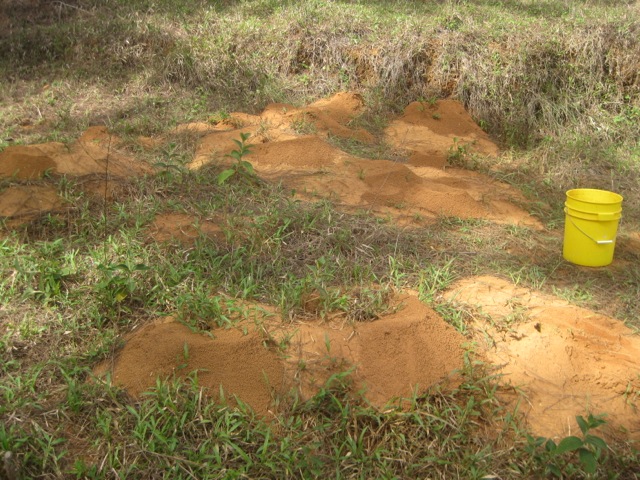
Where are these guys coming from?  I didn't have to look further than the empty lot next door.  There is a huge colony of them there.  I have been using their dirt to make my mud brick stoves for quite a while now.  It is finely ground up and mixes very easily.   Here you can see how many anthills they have made.  I took out seven five gallon buckets of their dirt the other day and didn't even use half of what was there.  Fortunately they don't mind - the dirt is just the excavation from their homes.  They don't attack humans, either.  


My problem now, of course, is how to protect my plants without resorting to poisoning the ants and the environment.  My neighbors mostly use ant poison, or else they pour gasoline down one hole and light the vapors which come up through another hole.  I have found out that there is one plant which produces leaves that repel them.  I have planted several, and hope that that works.  Fortunately the leaf cutters don't like tomatoes or eggplants, which have been growing well.


Our tomatoes came in well, as did our beans before the ants discovered them!

We couldn't end without including this photo of Isidro and his younger brother Kevin on Isidro's bike.  Our town handed out free bikes a few months ago to needy kids.  Isidro chose to get a little bike instead of an adult one, and he fixed it up with all the bells and whistles.  He is very proud of his air horn.  He took an old fire extinguisher tank and connected it to two horns.  He then pumped the tank full of air with a hand pump.  When he hits the valve on the fire extinguisher, it sounds just like a Mack truck!  

His sign reads "Dios es amor" (God is love)


Steve and Heather


Tuesday, April 23, 2013

El Valle, Panama

We recently took a trip to the mountain resort of El Valle on our way to Panama City for our yearly medical checkups (we passed, by the way).  El Valle is actually a town located in the center of a volcanic crater.  Luckily the volcano has been inactive for a very long time. This area has a very mild climate and has lots of foreigners living there. We had a local guide (Mili) who showed us the way up one of the local attractions, the Sleeping Indian.

Our guide for the day

Here is the view of the ridge that looks like a sleeping Indian.  The face is to the right. You can find the legend of the sleeping Indian princess here.


Lots of people were on the head of the Indian

On the way down, we saw some "strangler figs".  These fig trees start with a seed being dropped by a bird in the upper branches of a tree.  The roots grow downward until they reach the ground, after which they grow up around the host tree and strangle it.  The trees below haven't killed off their host trees yet.


Last Sunday was Heather's birthday.  We decided to go back to our favorite waterfall, "El Salto".


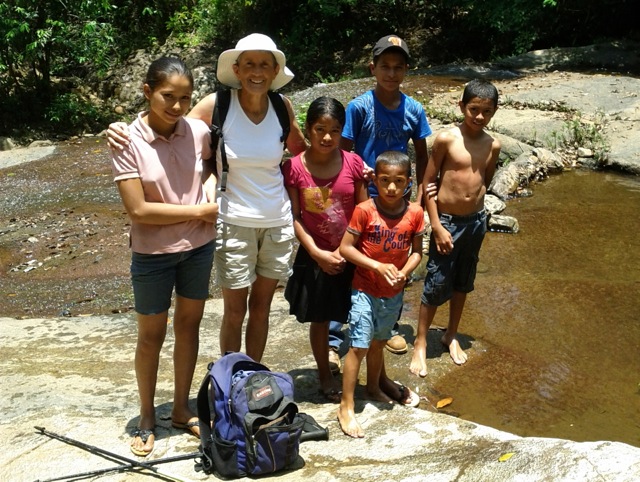
We passed the house of one of our students, Migdalia, who joined us with her sister, brothers and cousins.  They swam with us for a while, and then asked us if we wanted to climb to the top of the waterfall.  We agreed, and they led us up a scramble up a steep slope with lots of loose dirt. Fortunately we could grab on to trees and roots.

Heather with Migdalia, Mileidis, Adelicio, Jorge, and Alberto

View from the top of the waterfall
They also took us to their private swimming hole a little further up the river, complete with a small water slide.

Their swimming hole/water slide
A few days later, we were sitting on our front porch around nightfall and two of our neighbors passed by, excited to show us that they had caught some giant cicadas, called totorrones.  They were very proud of themselves, describing in detail how they were able to sneak up on the big insects and trap them with a drinking glass against a tree trunk.


Kevin and Meicol (Michael) show off their catches

Kevin and Meicol also explained to us how you could keep a totorron as a pet by tying a piece of thread around its neck as a leash and allowing him to fly around a bit.  They gave me one of their bugs, but I let him go after they left.


My share of the day's catch
The next day they told me that the thread around the neck idea hadn't worked.  Neither bug survived :(  I guess totorrones just aren't cut out to be pets.

That's it for now!
Steve and Heather

Friday, April 5, 2013

Month of March


The month of March was a busy one for us, so busy that we didn't have time to do a single blog entry.  We had two sets of visitors - a newly arrived Peace Corps couple and also dear friends from New Jersey.  Heather spent a week teaching the new Peace Corps trainees in the Teaching English group.  Steve was busy making stoves before the dry season ends in early April.

Our first task was to prepare the house for our visitors.  We only have one bedroom, so our guests sleep in the living/dining area.  We decided to make a bamboo room divider to give them more privacy.

First we asked our neighbor Andrés to cut us a couple of 30 ft bamboo poles.  He charged us 25 cents for each one.

Andrés felled and trimmed the poles


Steve learned how to split the bamboo into quarters with a machete.  


 Steve nailed the bamboo slats together and Heather sewed the cloth backing.   Here is the finished product.


Our first guests were Max and Lorraine, a young couple from Wisconsin. They are Peace Corps trainees, and had only been in Panama for two or three weeks.  They spent four nights with us, learning how Peace Corps volunteers live in the field.


We showed them the sights of Chepo.  We hiked up the Alto del Higo, the highest mountain in our province, to get a view of the Pacific.  We swam in two different rivers, met lots of local kids, and gave them a tour of the school.  On our hike we saw more leaf cutter ants, and got a good photo of them busy at work.  


I don't know how they manage to carry those leaves.  It looks like they are only using one leg to balance the leaf on their head.  Interestingly enough, they don't eat the leaves.  They bring them back to their nest, where they feed the leaves to a fungus.  They eat the fungus.

Our next visitors were Dave and Jani.  Dave and Steve worked together at Princeton Day School for many years.  We only had a week, but we managed to pack a lot of activities into the short time we had with them.  

On their first evening in Panama City we were lucky to catch the sunset in the old quarter.


One of the highlights of the trip was bird watching at the Rainforest Discovery Center.  They had a 100 foot tower which got us above the trees.


After a short visit to Chepo, we headed to the beach.  We got an email from the Peace Corps warning us that there would be high waves.  They were right!  Steve and Dave had a great time body surfing, though they did have to let the bigger waves go by at times. 

Steve and Dave during a lull in the waves


The hotel grounds were beautiful!

Their visit was all too short, but very memorable.

The next week Heather stayed on in Panama City for training sessions with the new Peace Corps recruits, while Steve went back to Chepo to make as many stoves as possible before the rainy season.  Here are a few pictures of the process.


That's it for now!

Steve and Heather